Ideas/stories/oddities concerning my favorite part of New York

Tuesday, November 3, 2009

Guss' Pickles - Why are they moving to Brooklyn?

It seems like Guss' Pickles will be out of the Lower East Side around the end of the year. It will be the end of a 99-year tradition, and another LES mainstay to join the list of mom-and-pop shops that can't pay the new, ridiculously high rent of the neighborhood.

The LES used to be the place for pickles. Guss' dates back to the 1900s, when a Polish immigrant named Isidor Guss opened up a stand. There were vendors all over the place. But with Guss' up and moving to Brooklyn, one of the traditions of Jewish immigrant life is that much closer to disappearing.

Apparently the rent has become too high for Pat Fairhurst, the owner, and the space just isn't big enough for her to brine the way she wants. The other day when I was down there I bought two pickles: a three-quarter sour, and a spicy pickle. Other varieties are half-sour and full-sour. They were both delicious, even though the spicy pickle was so hot my ears started burning. It was a wonderful taste experience.

The gentrification of the Lower East Side has brought along many wonderful eateries, including Il Laboratorio del Gelato, a homemade ice cream stand on Orchard Street, and the Roasting Plant, also on Orchard, a cafe that roasts its coffee beans freshly every day. But what about the shops of immigrant life that have survived the years? There are still a few knisherys and delis scattered throughout the neighborhood, but it seems like the loss of Guss' is just the continuation of an old-world exodus.


Probably the spiciest pickle in New York - maybe on earth.

Are the Lower East Side tenements really gone?

For many, the Lower East Side of Manhattan has become completely gentrified - swanky bars and organic coffee shops mark dozens of street corners. The rent can match that of apartments on the Upper East Side. But walk far, far east, and the 19th century tenement slums the LES was known for seem reincarnated in sky-high public housing buildings.

Walking south on Allen Street, I noticed that park benches and greenery are starting to pop up on the median of the two-way street. According to a podcast tour I took of the LES a few months ago for my NYU Beat Reporting Downtown class, Allen Street used to have another row of tenement buildings right down the center. It's hard to imagine squeezing in an entire block of buildings, even though this street is technically a wide boulevard. But now, instead of smelly, dirty, unsafe apartments, the median on Allen Street is just another place to sit and drink your shade-grown coffee.


In fact, the dilapidated tenements of the 19th century are now swanky high-priced apartments, or historical sites. The devastation and poverty that plagued this area 100 years ago seems to have disappeared completely. There's even the Tenement Museum, for the majority of us who can't imagine the LES as the former home of the worst slums on earth.


But is this LES poverty really gone? If you walk east, and I mean so east that you almost hit the river on Grand Street, you see a New York that feels forgotten. It is not in the guidebooks, retail stores are few and far between, and I saw street names that I didn't recognize, far beyond Orchard, Norfolk, and Clinton. The housing projects on the East River rise to staggering heights, but their poverty can seem as low as that of the old Lower East Side, the filth and despair that used to pervade the wealthy streets of today.


Down here, far east, streets are named after important Jewish people. There's a Rheba Liebowitz Square, and an Abraham Kazan Street. But most of the Jewish families have left, replaced by low-income Hispanic, black, and Asian families. In this area below Houston Street and east of Columbia, 38-49 percent of families are below the poverty line, with the median income as low as $11,963, according to the census profile of the district in 2000.

Maybe the dirty windows and ancient air conditioning units of the housing projects down here cannot be rightfully compared to the tenements of the past, but walking through this neighborhood, then circling back on Orchard towards home amid the fancy boutiques and gourmet food stores, makes it hard to ignore the "history repeating itself" feeling. Many people say that the Lower East Side has become completely gentrified, but this Lower East Side, just a few blocks from the river, is completely removed from this renewal.

Monday, November 2, 2009

A Trip to the WTC Tribute Center, 10/28/09

Last Wednesday I went to Tribute WTC Visitor Center on Liberty Street with my NYU Beat: Reporting Downtown class. The war ideology that developed behind 9/11, and that eventually engulfed it, has always felt so over-analyzed and drawn out to me. Before the field trip I felt rather ambivalent about going.

Although that feeling did stick with me during several parts of the visit - the melodramatic music on the audio tour didn't help - I realized there is a point to the center, to the plans for the new World Trade Center buildings and memorial. It is to make sure that no one will forget what happened that September, over eight years ago, when two planes hit the Twin Towers and killed 2,749 people. It seems like the meaning of that day can be distorted by war and xenophobia. However, the center did a great job of sticking to what was pure, inspirational and literal: keeping the memory of those who died alive.

Wednesday was rainy, and my 14 classmates and I splashed through the streets to reach the World Financial Center. Looking through the windows towards Ground Zero, we listened to an audio tour given by a father who lost his son on 9/11, a firefighter. After hearing that only 174 whole bodies were recovered from the wreckage, and that it only took 10 seconds for one 110-story building to fall, the damp, disordered construction site was truly impacting. It was the most emotional and disturbing field trip I have ever been on, but also one of the most important.

"Sept. 12 was the worst day, because Sept. 11 we still had hope," said a woman on the audio tour whose husband was never recovered. After our return to the center, we saw images and video of what we had merely heard about. A collage of hundreds of "Missing" signs was plastered on one side of the room. Videos of the WTC before 9/11, and then the devastation of that day in 2001, play again and again on flatscreen TVs on the other side.

After absorbing gruesome photos of the wounded, and items retrieved from the catastrophe (including a piece of one of the jetliners), we went downstairs to hear a truly emotional speech. Tracy Gazzani, a volunteer docent, spoke about the loss of her 24-year-old son Terri, who worked on the 104th floor of the North Tower. "He was cut off from all exits," said Gazzani. "Terri was never recovered." She spoke about the process of grief and why she decided to volunteer for the tribute center. "It's my way of giving back, because people from all over the world came to help us. 9/11 was like dropping a pebble onto a piece of glass and having it spider out. It affected so many people."

When the tour was over, I walked to the World Trade Center subway stop, which has never changed its name even though the buildings are gone. I realize now how important this is, because sometimes a name is all we need to remember something so vast and tragic.

Wednesday, October 21, 2009

An Interview with Pete Hamill at NYU's Journalism Institute

As novelist and newspaperman Pete Hamill reads from his 2004 book “Downtown: My Manhattan,” a cultural and personal history of New York below Times Square, his voice comes out heavy and sincere, as if every detail is the most important one in existence. Hamill visited my The Beat: Reporting Downtown class at NYU on Wednesday, to be interviewed by 15 students. He slowly and lovingly sounds out his written words like it is his favorite book to read, although it seems that he feels this way about every book he has written, or has ever read. I want to love what I write as much as he does.

“How full of marvels was the world!” Hamill reads from the last chapter of “Downtown,” and after interviewing him, it’s clear that this is how he views life. He has a warm, easygoing manner, and delivers grand pauses between his sentences that make me think. Every interest in his life refers back to his greatest passion: writing. Whether he speaks about sports (“Basketball is beautiful- you see Michael Jordan and you say ‘Wow, I wish I could write like that”) or jazz music, it all ties in to being a writer (what he says is “being guilty with an explanation”).

Hamill is 74 years old, but looks very youthful, like he has never lost his intense curiosity and compassion that according to him, come with the best reporters. He says he will not stop writing until he is carried off to his grave. However, writing was not the first profession that appealed to him. He went to college in Mexico City on the GI Bill, and was so intimidated by the Mexican artists of the time that he says he “failed into writing.” He was attracted to writing because of “the sense of possibility of seeing the world,” which led to him choosing the navy instead of the army in his younger years.

Hamill is currently working on a novel, a mystery revolving around the current recession in New York City, that is due to come out in late spring of 2010. He has been a Distinguished Writer in Residence at NYU for four years now, and says he loves meeting out-of-town students who are seeing New York “for the first time in a real way.” Undergrads recount these experiences in Street Level, a publication that Hamill runs.

Pete Hamill has had an exciting life, and in the way he describes the joy of sports (as an “unscripted drama”), one sees his passion for spontaneity and surprise that comes with reporting and writing.


Pete Hamill's 2004 book "Downtown: My Manhattan"

Trip to the Fales Library at New York University's Bobst

I saw something a few days ago that changed my life. On Wednesday in my Beat reporting class we visited the Fales Library & Special Collections, NYU’s accumulation of rare books, artifacts, and other unique literary objects at Bobst Library. I’ve never found libraries boring, and this field trip renewed my desire to work with books. Apparently there are at least 15,000 rare titles or editions!

The head librarian at Fales who talked with us about the library’s most interesting (I think) asset, the ”Downtown Collection,” has my dream job. His name is Marvin Taylor and he gets to wear Converse sneakers to work. Fifteen years ago he started this collection of art, music, and literary materials created during the '70s, '80s and '90s, all coming out of downtown New York. Apparently no one else was taking this scene seriously, as something important to preserve.

Marvin has collected Patti Smith’s diary, original photos of the Ramones, and this wooden orange box full of writer David Wojnarowicz’s oddities, including a monkey skull painted Klein blue. He made sure we knew punk rock was invented in New York, not England, and had a few of us read excerpts aloud from punk diaries and artists’ screenplays.

I haven’t seen someone recently so completely passionate about his job, and so tender with the materials that he works with. He quoted someone, I forget now who, saying, “A thing (as in an artifact) is just a really slow event.” I think that’s pretty amazing.


The many floors of NYU's Bobst Library

A free podcast tour of Lower East Side

I'm always a little iffy about walking tours with guides - it can be hard to hear them, to catch up with them, and taking the tour at a leisurely pace is next to impossible. So finding a free podcast tour of the Lower East Side, that I could download onto my iPod, might have been less personal, but it was definitely more satisfying.

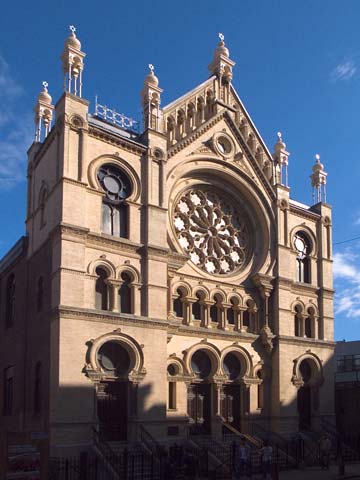
Although the Lower East Side runs east from Bowery all the way to the Williamsburg Bridge, it starts for some at the Eldridge Street Synagogue, fitting for the neighborhood’s rich Jewish immigrant history. Imposing and beautiful, Eldridge’s Star of David engravings contrast sharply with Chinese bakeries across the street. It’s what the Lower East Side, nicknamed the “gateway to America”, embodies: a mélange of cultures just a few sidewalk steps apart. This is what the tour provided by the Lower East Side Business Improvement District emphasizes. Different cultures, time periods, and creeds are all explored with equal depth and clarity on this fascinating walking tour.

From Eldridge, the tour takes a right on Canal and crosses Allen, an eight-lane street that used to have an extra row of tenements - cheaply made housing for immigrants - through the middle. It turns left on Orchard Street and goes north. A street wealthy with the new and old, Orchard houses almost everything the LES has to offer, starting with surviving tenement buildings.

During the late 19th century, this area used to be the world’s most populated: there were 240,000 people per square mile. Now, Orchard is quiet in many parts, peaceful. The street is closed on weekends for pedestrian traffic, and storeowners lug their wares outdoors. This is the Bargain District, where garment sweatshops used to rule; now fancy boutiques stand next to mom-and-pop shops.

Further up, the tour suggests a spicy pickle at Guss’ on the corner of Orchard and Broome. And the few Jewish delis that remain require a visit, with the menu at Katz’s still partially in Yiddish. When the tour gets to Houston, the LES has officially ended, but one can still find fresh knishes at Yonah Schimmel’s a few blocks west.


The Eldridge Street Synagogue